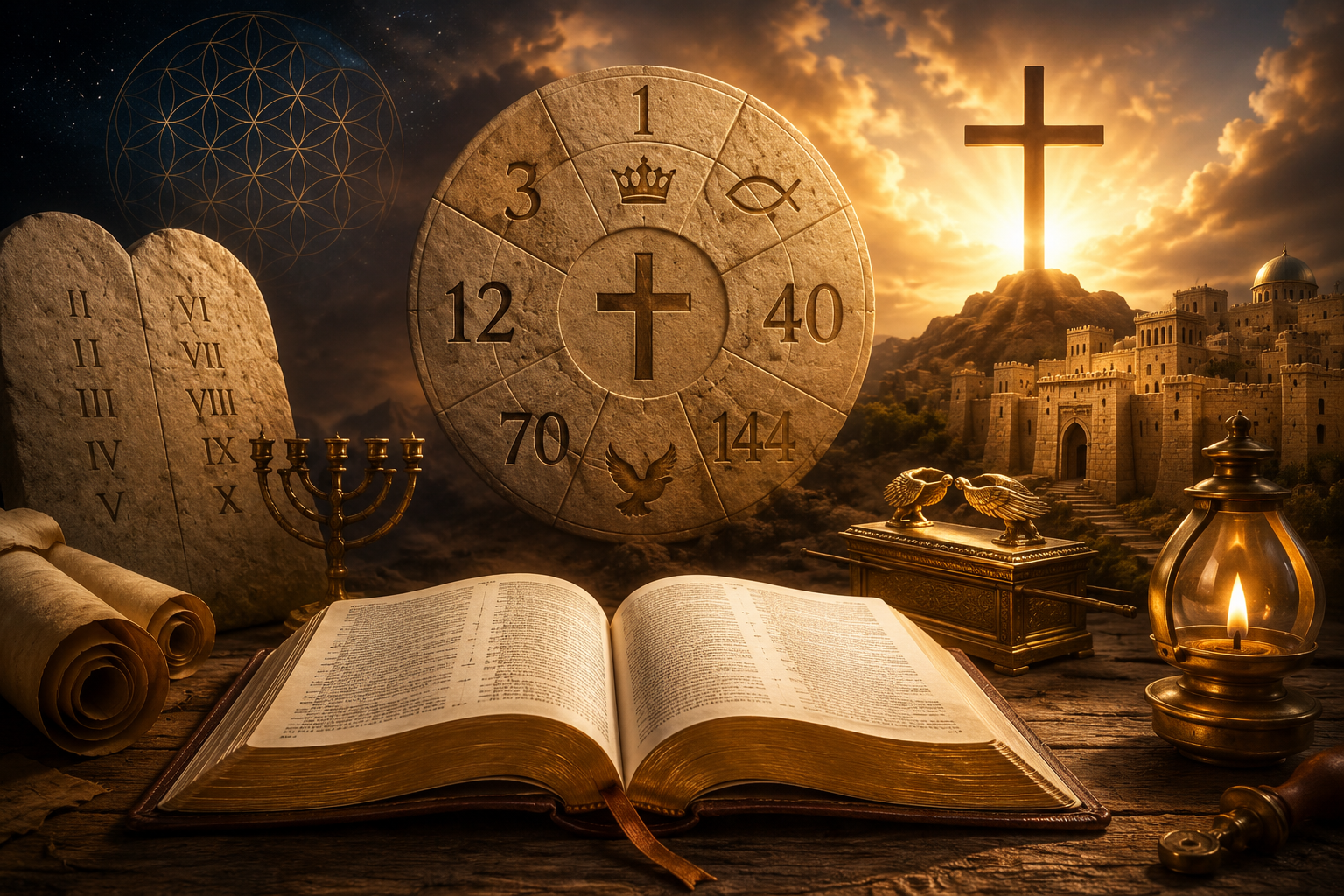
Biblical Symbolism and Numbers: Discovering the Real Meaning of Scripture
Have you ever flipped through your Bible and noticed that certain numbers keep popping up? You are reading about the creation of the world, and there is the number seven. You switch over to the story of Noah’s Ark or Jesus in the wilderness, and suddenly the number forty is everywhere. Then you read the Book of Revelation, and it feels like an entire mathematical grid of sevens, twelves, and thousands.
It makes you wonder: Is God trying to tell us something beyond the literal facts?
The short answer is absolutely yes. When we dive into Biblical Symbolism and Numbers, we are not just looking at cold, hard statistics or random data points. We are looking at a beautiful, divinely inspired language designed to show us the character, order, and plan of God. Understanding the meaning of numbers in the Bible opens up a whole new layer of depth in our daily scripture reading, enriching our walk with Christ.
But before we dig into the deep spiritual meanings, let’s clear the air on one vital point: Biblical Numbers and Their Meanings have nothing to do with modern, secular numerology or New Age “angel numbers.” We aren’t trying to predict the future, find a hidden fortune-telling code, or practice divination, which scripture clearly warns against (Deuteronomy 18:10-12). Instead, we are looking at how God uses consistent patterns across both the Old and New Testaments to highlight His eternal truths.
Let’s take a casual, faith-centered look at how understanding these patterns can breathe new life into your personal quiet time and help you grasp Bible meanings like never before.
Why Did God Use Symbolism and Numbers?
To understand Biblical symbolism explained naturally, we have to put ourselves in the shoes of the ancient ancient Near Eastern and Greco-Roman audiences. Long before printing presses, smartphones, or digital study tools existed, people passed down Scripture and oral traditions through memorization and public reading.
In ancient Hebrew and Greek cultures, numbers were frequently used as literary design patterns. They served as mental anchors to help people remember important theological concepts. When an ancient Israelite heard that a trial lasted “forty days,” their mind immediately flashed to testing, preparation, and spiritual dependence on God.
More importantly, numbers reveal God’s meticulous design. Nothing in your Bible is accidental. Every chapter, verse, character, and quantity is deliberately placed. When we look closely at the spiritual meaning of numbers in Scripture, we start to see that the same God who ordered the laws of physics and mathematics also ordered the history of salvation.
The Key Bible Numbers and Their Meanings
Let’s break down the most prominent numbers you will encounter in God’s Word. When you look at these examples, you will see how beautifully the Old and New Testaments connect, proving that the entire Bible is one cohesive, divinely inspired narrative.
       [1] Unity & Sovereignty (The Shema)
        │
       [3] Divine Completeness (The Trinity)
        │
       [6] Man & Incompleteness (Short of Perfection)
        │
       [7] Divine Perfection & Rest (Creation Week)
        │
       [12] Covenant Order & Government (Tribes / Apostles)
        │
       [40] Testing, Trial, & Preparation (Wilderness)
Number 1: Unity and Absolute Sovereignty
The number one in Scripture stands for absolute unity, supremacy, and the unique identity of God. It tells us that God has no competitors, no equals, and stands completely alone as the Creator of the universe.
- The Scriptural Anchor: The foundational confession of the Jewish faith is the Shema: “Hear, O Israel: The Lord our God, the Lord is one” (Deuteronomy 6:4).
- The Christian Application: In the New Testament, this unity extends to the Body of Christ. Paul reminds us in Ephesians 4:4-6 that there is “one body and one Spirit… one Lord, one faith, one baptism; one God and Father of all.” When we seek unity in our local churches, we reflect the ultimate oneness of God.
Number 2: Witness, Confirmation, and Division
Whenever you see the number two, think of validation, legal witness, and the confirmation of a matter. It is also used to show a clear division or contrast between two options.
- The Scriptural Anchor: Under Biblical law, a matter could only be legally established by the testimony of at least two witnesses (Deuteronomy 19:15). We see this pattern clearly when Joseph interprets Pharaoh’s dreams in Genesis 41:32. Joseph explains that because the dream was given twice, the matter was firmly established by God and would happen soon.
- The Christian Application: Jesus sent out His disciples two by two (Mark 6:7) to preach the Gospel. Why? Because their joint testimony carried legal and moral weight. In our own lives, standing together with a brother or sister in Christ provides mutual accountability and confirms our witness to the world.
Number 3: Divine Completeness and the Trinity
Three is widely recognized as the number of divine completeness, wholeness, and spiritual intensity. It signifies that something is entirely solid, stable, and completely finished by God.
- The Scriptural Anchor: We see the triune nature of God woven throughout Scripture—Father, Son, and Holy Spirit (Matthew 28:19). In Isaiah 6:3, the angels don’t just say God is holy; they cry out, “Holy, holy, holy is the Lord of hosts,” using a three-fold repetition to express the absolute peak of His holiness. Most importantly, Jesus Christ was raised from the dead on the third day (Luke 24:7), signifying the ultimate completion of our redemption.
Number 4: The Earth, Creation, and Universality
If you see the number four, look down at the ground or out at the horizon. Four is inherently linked to the physical creation, the earth, and global universality.
- The Scriptural Anchor: Genesis 2:10 mentions four rivers flowing out of Eden to water the earth. In prophecy, we frequently read about the “four corners of the earth” (Isaiah 11:12, Revelation 7:1) or the “four winds of heaven,” which simply mean all geographical directions (North, South, East, and West).
- The Christian Application: The global scope of the Gospel is anchored in this number. God’s salvation isn’t restricted to one tiny pocket of the world; it covers all four corners of the earth, reaching every tribe, tongue, and nation.
Number 5: Grace, Favor, and Divine Provision
Five is a beautiful number that represents God’s unmerited favor, goodness, and transforming grace toward broken human beings.
- The Scriptural Anchor: Look at how God changed Abram’s name to Abraham and Sarai’s name to Sarah (Genesis 17:5, 15). In Hebrew, He inserted the fifth letter of the alphabet, Hey ($\pi$), which symbolizes breath and grace, right into the middle of their names. Later, Jesus took five loaves of bread to feed five thousand people (Matthew 14:17-21), demonstrating God’s abundant grace and overwhelming provision for our physical and spiritual needs.
Number 6: Man, Human Weakness, and Incompleteness
Six is the number of humanity, but it carries a warning label. Because it falls exactly one step short of the perfect number seven, six represents human effort apart from God—imperfection, labor, and spiritual incompleteness.
- The Scriptural Anchor: Mankind was created on the sixth day of creation (Genesis 1:27, 31). Furthermore, humanity was commanded to labor for six days out of the week before entering holy rest. In the Book of Revelation, the notorious “number of the beast,” 666, is explicitly called the “number of a man” (Revelation 13:18). It is a three-fold repetition of imperfection—humanity trying to elevate itself to the status of God but failing miserably.
Number 7: Divine Perfection, Covenant, and Rest
Without a doubt, seven is the crown jewel of biblical numbers. It appears hundreds of times across the pages of Scripture, representing total completion, spiritual perfection, and the sacred covenant of God.
- The Scriptural Anchor: God finished His creative work on the sixth day, and on the seventh day, He rested, sanctifying it as a holy day (Genesis 2:2-3). The walls of Jericho collapsed only after the Israelites marched around them seven times on the seventh day (Joshua 6:15-20). In the New Testament, when Peter asked if he should forgive a brother seven times, Jesus pushed the number to infinity by telling him to forgive seventy times seven (Matthew 18:21-22), indicating boundless, perfect grace.
Number 10: Quantitative Fullness and Responsibility
Ten represents a complete cycle of human responsibility, legal order, or a comprehensive sum of something in the physical world.
- The Scriptural Anchor: God gave Moses the Ten Commandments (Exodus 20) as the complete summary of the moral law. We also see ten plagues poured out upon Egypt (Exodus 7-12) to demonstrate God’s total, absolute judgment over Pharaoh’s false gods.
Number 12: Covenant Order, Government, and God’s People
Whenever you see twelve, think of divine administration, organizational perfection, and the family of God. It is the number that defines how God structures His chosen people.
- The Scriptural Anchor: The Old Testament foundation relies on the twelve tribes of Israel (Genesis 49), while the New Testament church is built upon the foundation of the twelve apostles (Matthew 10:1-4). When you look at the description of the New Jerusalem in Revelation 21, the number twelve is everywhere: twelve gates, twelve foundations, and twelve pearls, showing that God’s eternal home is perfectly ordered for His covenant people.
Number 40: Testing, Trial, and Spiritual Preparation
Forty is never a comfortable number in Scripture, but it is always deeply transformative. It signifies a necessary period of testing, trial, purging, and intense spiritual preparation before a major move of God.
- The Scriptural Anchor: The great flood rained down for forty days and forty nights during Noah’s time (Genesis 7:4). Moses spent forty days on Mount Sinai receiving the Law. The Israelites wandered the wilderness for forty years to learn trust and obedience. In the New Testament, Jesus fasted and was tempted by Satan in the wilderness for forty days (Matthew 4:1-2) before launching His public ministry.
Quick Reference: Biblical Symbolism and Numbers
To help you easily visualize these patterns during your personal Bible study, here is a master table outlining the primary symbols and numbers we have discussed.
| Number | Primary Spiritual Meaning | Key Old Testament Example | Key New Testament Example |
| 1 | Unity, Sovereignty, Oneness | The Shema (Deuteronomy 6:4) | One body, one faith (Ephesians 4:4-6) |
| 2 | Witness, Legal Confirmation | Joseph’s double dreams (Genesis 41:32) | Disciples sent two by two (Mark 6:7) |
| 3 | Divine Completeness, Trinity | “Holy, Holy, Holy” (Isaiah 6:3) | Resurrection on the 3rd Day (Luke 24:7) |
| 4 | Earth, Creation, Universality | Four rivers of Eden (Genesis 2:10) | Four corners of the earth (Revelation 7:1) |
| 5 | Grace, Favor, Provision | Name changes of Abraham/Sarah | Feeding of the 5,000 (Matthew 14:17) |
| 6 | Man, Imperfection, Weakness | Creation of man on Day 6 (Genesis 1:27) | Number of the Beast: 666 (Rev 13:18) |
| 7 | Perfection, Covenant, Rest | God resting on Day 7 (Genesis 2:2) | Forgiveness 70×7 (Matthew 18:22) |
| 10 | Legal Order, Full Responsibility | The Ten Commandments (Exodus 20) | Ten virgins, ten talents parables |
| 12 | Covenant Administration | Twelve Tribes of Israel (Genesis 49) | Twelve Apostles chosen (Matthew 10) |
| 40 | Testing, Trial, Preparation | 40 years of wandering (Numbers 14:34) | 40 days of wilderness temptation (Matt 4) |
Deeper Spiritual Concepts: Beyond Just the Digits
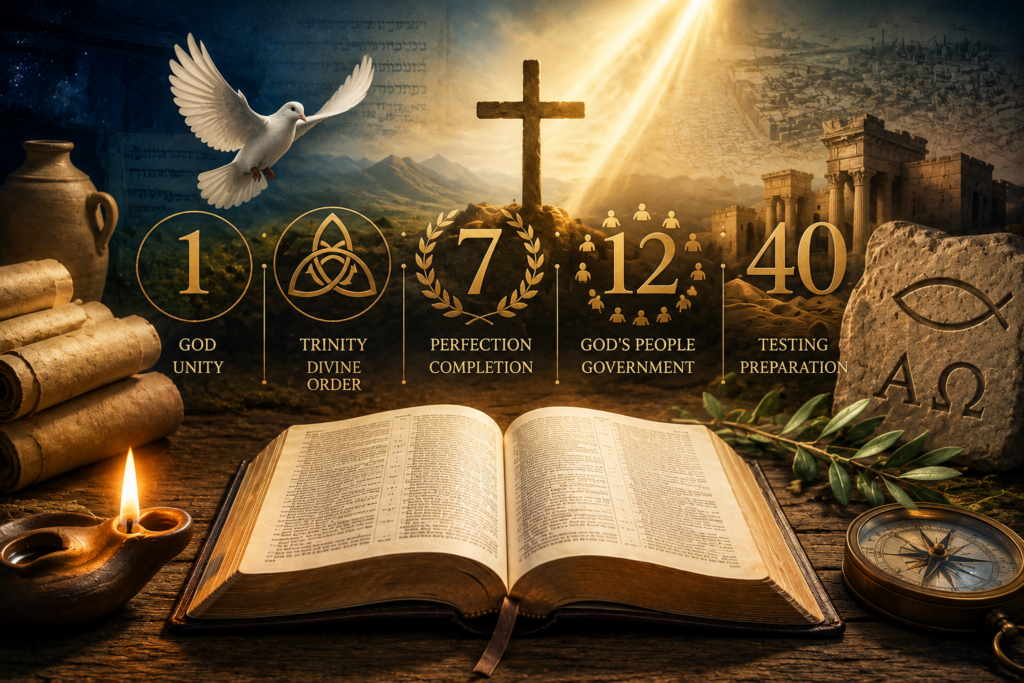
When we talk about Bible symbols and their meanings, we shouldn’t limit our focus entirely to basic numbers. Scripture also uses physical items, colors, and animals to build out its grand themes. Let’s look at three massive symbolic concepts that frequently intersect with numerical patterns across the word of God.
1. The Tabernacle and Temple Dimensions
If you read the book of Exodus or 1 Kings, it is easy to get bogged down in the endless measurements of curtains, rings, posts, and altars. But these dimensions are a masterclass in Biblical symbolism and numbers.
The Holy of Holies—the innermost sanctuary where God’s presence rested—was a perfect cube. In the Tabernacle, it measured $10 \times 10 \times 10$ cubits. In Solomon’s Temple, it was enlarged to $20 \times 20 \times 20$ cubits. The use of tens and perfect squares was an architectural message to the priests: God’s presence is perfectly balanced, absolute in holiness, and completely ordered. ### 2. Gematria: The Numerical Value of Names
You might hear Bible scholars talk about a concept called gematria. This is simply the ancient practice of assigning numerical values to letters of the alphabet (since ancient Hebrew and Greek didn’t have separate symbols for numbers like our 1, 2, 3).
A famous example of this is found right at the beginning of the New Testament. In Matthew 1:17, the author deliberately structures the genealogy of Jesus into three groups of fourteen generations. Why fourteen? In Hebrew, the name “David” ($D-V-D$) adds up to exactly fourteen ($4 + 6 + 4 = 14$). By structuring the genealogy this way, Matthew is subtly shouting to his Jewish readers: Look at the numbers! Jesus is the ultimate Son of David, the long-awaited Messianic King!
3. Prophetic Time Frames
In apocalyptic literature like Daniel and Revelation, you will frequently run across puzzling fractions of numbers, like “three and a half years”, “forty-two months”, or “1,260 days” (which all equal the exact same length of time).
Because three and a half is exactly half of seven, it represents a broken cycle—a period of intense trial, human suffering, and persecution that is strictly limited by God. It reminds us that even when the world feels chaotic and broken, God has put a literal countdown clock on evil. It cannot last one second longer than He allows.
4 Common Misconceptions About Bible Numbers
Because this topic captures our imagination so easily, it is incredibly easy to wander off track. Let’s look at a few common myths and set the record straight using healthy, sound biblical interpretation.
| The Misconception / Myth | The Scriptural Truth & Balanced Perspective |
| Myth 1: Every single number in the Bible has a deep, hidden, mystical code. | Truth: Sometimes a number is just a literal count. If a passage says a boy caught fish or a wall was built by a certain number of men, it is usually just recording historical facts. Context determines whether a number is symbolic. |
| Myth 2: We can use Bible numbers to predict the exact date of Christ’s return. | Truth: Jesus completely shattered this idea in Matthew 24:36, stating that “concerning that day and hour no one knows.” Anyone trying to use prophetic timelines to map out an exact calendar date is ignoring Christ’s direct command. |
| Myth 3: Biblical numbers operate like New Age “Angel Numbers.” | Truth: Angel numbers teach that repetitive sequences (like 111 or 444) seen in daily life are signs from the universe. The Bible teaches that our guidance comes from the Holy Spirit and Scripture, not by looking for omens in digital clocks. |
| Myth 4: Gematria means there is a hidden secret gospel under the text. | Truth: Gematria was a literary tool used by ancient authors to highlight themes that already existed openly in the text. It was never used to create secret, contradictory doctrines or occult philosophies. |
5 Practical Lessons for Your Personal Faith Journey
Understanding Biblical Symbolism and Numbers isn’t meant to turn us into ivory-tower theologians or amateur code-breakers. The goal of studying Scripture is always personal transformation and a closer relationship with Jesus Christ.
Here are five simple, practical ways you can apply these spiritual lessons to your daily life today.
1. Rest in God’s Sovereign Timeline
When you look at the perfect timing of the cross—how Jesus arrived at the exact right moment in human history, died on the Passover, and rose on the third day it proves that God is never rushed, never late, and completely in control of the clock.
Your Life Application: If you are currently in a season of waiting, feeling like your prayers are bouncing off the ceiling, take a deep breath. The same God who ordered the ages has a beautiful, calculated design for your personal life. Trust His timeline; His fulfillment always arrives at the perfect moment.
2. Embrace the “Forty Days” of Testing
Nobody enjoys going through seasons of financial hardship, relational strain, or spiritual dryness. But when we realize that the number forty represents a necessary period of testing before a massive spiritual promotion, our perspective shifts completely.
Your Life Application: Instead of begging God to immediately remove you from a difficult wilderness season, start asking Him: “Lord, what are You trying to teach me in this wilderness? How are You purifying my faith right now?” Let the trial do its perfect work in strengthening your spiritual roots.
3. Pursue True Unity in the Body of Christ
Because the number one emphasizes the unique oneness of our Creator, our unity as a church community is incredibly precious to Him. Disunity, gossip, and bitter division tarnish the reflection of God’s character to the surrounding world.
Your Life Application: Make a conscious effort to be a peacemaker in your local church family, your small group, and your household. Prioritize love, forgiveness, and mutual respect, honoring the prayer of Jesus that we would all be one just as He and the Father are one (John 17:21).
4. Stop Relying on the “Number Six” (Human Effort)
Many of us fall into the exhausting trap of trying to earn our salvation, our worth, or our standing before God through raw human effort. We strive, work, and burn ourselves out, yet we always fall short of the perfect rest found in Jesus.
Your Life Application: Remember that human effort apart from God is a permanent “number six”—it always falls short. Step away from legalism and performative religion. Learn to rest entirely in the finished work of Jesus Christ on the cross, entering into His true spiritual Sabbath.
5. Open Your Eyes to Literary Design Patterns
The next time you open up your Bible for your morning devotions, don’t just skim past the details. Keep a sharp eye out for repeating numbers, colors, symbols, or locations.
Your Life Application: Grab a journaling notebook. Whenever you see a number like three, seven, twelve, or forty, write it down down in the margins. Cross-reference it with other passages. You will be amazed at how quickly you begin to spot the beautiful, golden threads of divine design woven across the entire canvas of Scripture.
A Prayer for Spiritual Discernment
If you want to start implementing these insights into your quiet time, take a moment to pray this simple prayer:
Heavenly Father, thank You for the incredible depth, beauty, and perfect design of Your Holy Word. Thank You that every single detail, down to the very numbers on the page, reflects Your brilliant mind and sovereign plan for my life.
Lord, grant me wisdom and spiritual discernment as I study Scripture. Help me avoid the traps of worldly speculation, and instead use these patterns to see the beauty of Jesus more clearly. Guard my heart against anxiety, teach me to trust Your perfect timing, and help me rest in Your finished work. In Jesus’ name, Amen.
Frequently Asked Questions
Is biblical numerology a sin?
Studying the symbolic meaning of numbers as intended by the human authors of the Bible is completely safe, healthy, and edifying. However, practicing secular numerology—such as using your birthdate, name values, or random numbers to divine the future, contact spirits, or determine your destiny—is a sin clearly condemned by Scripture (Deuteronomy 18:10). Always keep your study anchored strictly within the bounds of biblical text and context.
Why is the number 7 mentioned so many times in the Book of Revelation?
The Book of Revelation is the ultimate climax of God’s plan for humanity, so it naturally utilizes the number seven to show that His work is coming to a total, perfect completion. John writes about seven churches, seven seals, seven trumpets, seven bowls of wrath, and seven spirits before God’s throne. This heavy repetition signals to the reader that God’s long-running covenant with creation is finally being perfectly fulfilled.
What does it mean when people talk about “Bible Meanings” of names?
Just like numbers, names in the Bible carry immense spiritual and symbolic significance. Names were frequently given to reflect a person’s destiny, character, or relationship with God. For example, Abraham means “father of a multitude,” and Jesus (Yeshua) means “The Lord is Salvation.” Looking up the original Hebrew or Greek meanings of names in a study dictionary can provide massive context to the stories you are reading.
What does the number 8 mean in the Bible?
Because the number eight comes immediately after the perfect completion of seven, it represents a new beginning, a fresh start, or a resurrection life. For example, exactly eight people stepped off Noah’s Ark onto a brand-new, cleansed earth (1 Peter 3:20). Additionally, newborn Israelite boys were circumcised on the eighth day to mark their official entry into God’s holy covenant.
Does God care about numbers in our modern day-to-day lives?
God cares deeply about every hair on your head and every single day written in your book (Psalm 139:16). However, He doesn’t expect you to navigate your daily life by deciphering cryptic numerical signs on highway billboards, license plates, or cash register receipts. Our daily guidance comes clearly through the timeless principles of the Bible, the wise counsel of the Christian community, and the gentle leading of the Holy Spirit inside us.
Final Thoughts: The True Goal of Scripture Study
At the end of the day, digging into Biblical Symbolism and Numbers should fill your heart with an overwhelming sense of awe and worship. It shows us that our faith is not based on clever myths, random fairy tales, or chaotic historical accidents.
Instead, we serve a brilliant Creator who carefully measured the waters in the hollow of His hand, meted out the heavens with a span (Isaiah 40:12), and masterfully ordered the history of our salvation. Every number, every symbol, and every shadow across the pages of Scripture ultimately points to one singular, glorious reality: the love of God revealed in Jesus Christ.
The next time you open up your Bible, remember that you are stepping into a beautifully designed temple of truth. Happy studying, and may God richly bless your time in His Word!