
The Bible Meaning of Elizabeth: Deep Spiritual Significance and Faith Lessons
Have you ever stopped to wonder if there is a deeper reason behind the names we find in Scripture? In the biblical narrative, names are never just random tags or trendy labels. They are profound declarations of identity, destiny, and the very character of God. If you are exploring the Bible meaning of the name Elizabeth, you are about to discover a beautiful tapestry of hope, covenant faithfulness, and divine timing.
Whether you are thinking about naming a baby girl, studying the heroines of the New Testament, or you keep encountering this name in your personal study, understanding what Elizabeth means in the Bible can deeply encourage your Christian faith.
Let’s dive into the rich Hebrew roots, the historical context, the prophetic symbols, and the practical life applications wrapped up in this timeless biblical name.
The Hebrew Etymology: What Does Elizabeth Mean in Bible Meaning?
To truly grasp the biblical meaning of elizabeth, we have to travel back to its original Hebrew form. Long before it was translated into the Greek Elisabet in the New Testament or anglicized into Elizabeth, the name was Elisheva (אֱלִישֶׁבַע).
This beautiful name is a compound of two powerful Hebrew words:
- Eli (אֵלִי): Meaning “My God.” It is a personal, intimate declaration of ownership and relationship.
- Sheva (שֶׁבַע): This root has a dual meaning in ancient Hebrew. It is the word for the number seven (the biblical number of completeness and perfection), but it is also the root verb for “to swear an oath” or “to bind oneself by a covenant.” When you put these two linguistic pieces together, the meaning of elizabeth translates beautifully to:
“My God is an oath,” “God is my promise,” or “God is an abundance.”
When someone in ancient Israel spoke the name Elisheva in bible meaning, they weren’t just shouting for a family member; they were actively proclaiming a theological reality: The Lord is a God who binds Himself to His word, and His promises are utterly unshakeable.
Elizabeth in the Bible: The Dual Scriptural Context
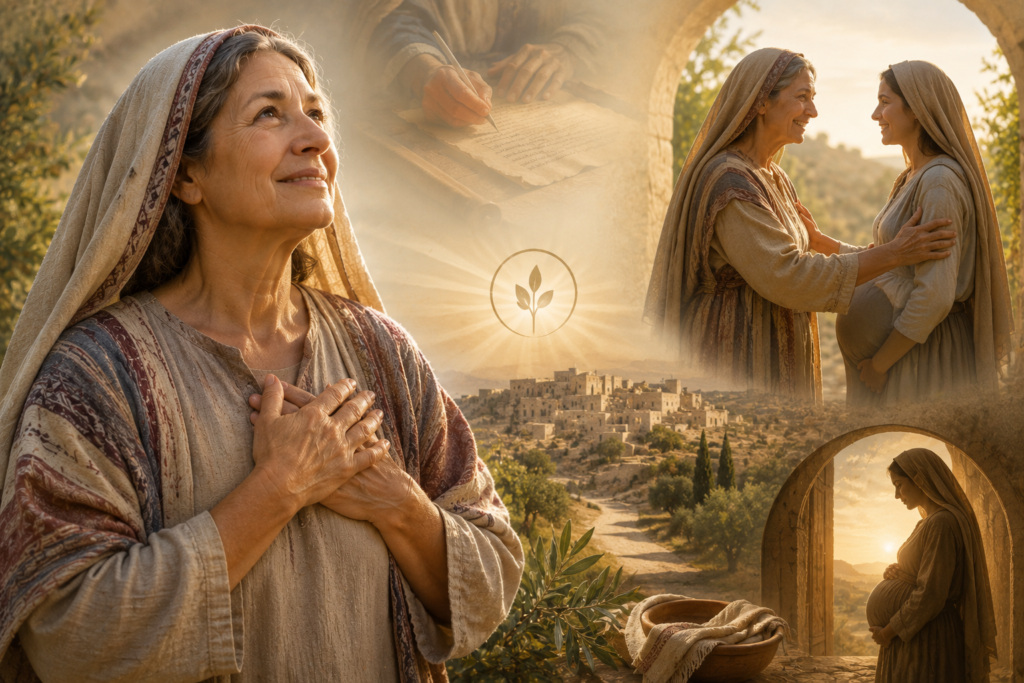
Many Bible readers automatically think of the New Testament when they hear the name Elizabeth. However, to fully respect the topical authority of this name, we need to realize it appears in both the Old and New Testaments, highlighting the beautiful continuity of the Christian faith.
1. The Old Testament: Elisheva, Wife of Aaron
The very first time we see this name in Scripture is in Exodus 6:23 in bible meaning. Here, she is called Elisheva, and she is the wife of Aaron, the first High Priest of Israel and brother of Moses.
By marrying Aaron, Elisheva became the matriarch of the entire Levitical priesthood. Her sons were the ones anointed to serve in the Tabernacle. This establishes an immediate connection between the name Elizabeth and concepts of holiness, priestly devotion, and direct service to God.
2. The New Testament: Elizabeth, Mother of John the Baptist
Fast forward centuries later to the Gospel of Luke, chapter 1. Here, we meet the most famous Elizabeth in the Bible. In a beautiful nod to historical continuity, Luke tells us that this Elizabeth was also a direct descendant of Aaron (Luke 1:5), and she was married to a priest named Zechariah.
This New Testament Elizabeth lived during a dark, silent era. For 400 years, there had been no prophetic word from God to Israel. On top of this cultural spiritual drought, Elizabeth carried a deeply personal ache: she was barren, unable to have children, and “well advanced in years” (Luke 1:7). In ancient Jewish culture, childlessness was frequently misunderstood as a sign of divine displeasure or a source of public disgrace.
Yet, it was into this exact setting of silent waiting and social reproach that God chose to show up, proving that the meaning of elizabeth in the bible meaning.
Old Testament (Exodus 6:23) ──> Elisheva (Wife of Aaron) ──> Mother of the Priestly Line
New Testament (Luke 1:5)    ──> Elizabeth (Wife of Zechariah) ──> Mother of John the Baptist
Competitor Analysis Summary: Where Other Guides Fall Short
Before we go any deeper into the spiritual dynamics, let’s take a look at what the broader landscape of Bible study guides covers regarding this topic. When checking the top ranking pages for bible meaning, several key trends emerge:
- Common Topics Covered: Most articles accurately define the Hebrew etymology (“God is my oath”) and give a basic retelling of Luke chapter 1, emphasizing her advanced age and the birth of John the Baptist.
- The Content Gaps: Many popular sources completely overlook the Old Testament connection to Aaron’s wife. They also glaze over the deep theological intersection between Elizabeth’s name and the Abrahamic Covenant, and they rarely offer concrete, real-world faith applications for modern believers going through dry seasons.
- Weak Areas: A lot of content lacks deep scriptural analysis of why the Holy Spirit filled Elizabeth, or they treat her story like a simple fairy tale rather than a historical account of a woman navigating severe cultural shame while staying blameless.
This comprehensive guide is designed to fill those exact gaps, offering a rich look at her prophetic role and providing actionable takeaways for your daily walk with Jesus.
Comparison Table: The Two Elizabeths of Scripture

To help you visualize how this name functions across both testaments, let’s compare the two women who wore it in the biblical text.
| Biblical Character | Scriptural Era | Marital Connection | Spiritual Lineage / Legacy | Core Theme |
| Elisheva (Exodus 6:23) | Old Testament / Exodus | Married to Aaron (The First High Priest) | Mother of the Levitical Priesthood; established the line of sacrificial service. | Covenant Foundations: God establishes His holy priesthood through an oath. |
| Elizabeth (Luke 1) | New Testament / Gospels | Married to Zechariah (A Priest of Abijah’s division) | Mother of John the Baptist (The Forerunner of Jesus Christ). | Covenant Fulfillment: God keeps His oath by sending the voice crying in the wilderness. |
4 Prophetic and Spiritual Meanings of Elizabeth
When we look at the life of Elizabeth in the Gospel of Luke alongside her name’s definition, several powerful spiritual motifs emerge. If you are looking for the deeper bible meaning of elizabeth, keep these four concepts close to your heart:
1. The Principle of Divine Timing and Patient Waiting
Elizabeth spent the majority of her adult life waiting for an answer to her prayers. Year after year, month after month, she had to face the quiet reality of an empty nursery. Yet, Luke 1:6 gives her and Zechariah an astonishing character reference:
“And they were both righteous before God, walking in all the commandments and ordinances of the Lord blameless.”
Her life teaches us that waiting on God is never wasted time. God wasn’t withholding a child from Elizabeth as a punishment; He was holding her story back so that her son could be born at the exact moment required to fulfill the prophecy of Malachi (Malachi 3:1).
2. The Removal of Disgrace and Reproach
When the angel Gabriel announced that Elizabeth would conceive, and her pregnancy became apparent, her response was full of worship. She said:
“Thus the Lord has dealt with me, in the days when He looked on me, to take away my reproach among people.” (Luke 1:25)
Spiritually, this reflects the grander narrative of the Gospel. Just as Elizabeth experienced a supernatural breakthrough that erased her earthly shame, Jesus steps into our lives to take away our spiritual reproach, turning our barren, empty places into testimonies of life and fruitfulness.
3. Spiritual Discernment and the Infilling of the Holy Spirit
One of the most thrilling moments in the New Testament happens when a young, newly pregnant Mary visits her older relative, Elizabeth.
“And it happened, when Elizabeth heard the greeting of Mary, that the babe leaped in her womb; and Elizabeth was filled with the Holy Spirit.” (Luke 1:41)
Without anyone telling her that Mary was carrying the Messiah, Elizabeth immediately knew. She cried out, “But why am I so favored, that the mother of my Lord should come to me?” (Luke 1:43). The spiritual meaning of elizabeth here is closely tied to profound spiritual discernment. She represents the heart that is sensitive enough to recognize the presence of Jesus, even when He is hidden from the rest of the world.
4. Faith in the Unseen Promise
In Luke 1:45, Elizabeth pronounces a blessing over Mary that serves as a core pillar for all Christian believers: “Blessed is she who believed that the Lord would fulfill his promises to her!” Because Elizabeth knew the pain of waiting and the ultimate victory of God’s word, she could confidently cheer on someone else’s faith. Her name reminds us that believing God’s oath brings deep, supernatural joy.
bible meaning Symbolism of the Name Elizabeth
When we look at numbers, names, and symbols in the Christian faith, Elizabeth’s story radiates with intentional design. Let’s break down some of these primary symbols in a dedicated reference table.
Biblical Symbolism Table
| Symbolism | Biblical Connection | Spiritual Reality for Believers Today |
| The Number Seven (Sheva) | The root of Elizabeth’s name means “seven” or “an oath.” | Represents spiritual perfection, completion, and the total rest we find in God’s finished work. |
| The Leaping Baby | John the Baptist leaping in Elizabeth’s womb (Luke 1:41). | Symbolizes prophetic recognition, joy in the presence of Christ, and waking up to our spiritual destiny. |
| The Barren Womb Made Fruitful | God supernaturally opening Elizabeth’s womb in her old age. | Demonstrates that nothing is impossible with God (Luke 1:37). He brings life out of dead situations. |
| The Priestly Garments / Lineage | Elizabeth’s identity as a daughter of Aaron. | Symbolizes our access to the presence of God as a “royal priesthood” through Jesus Christ (1 Peter 2:9). |
Real-World Faith Examples: Lessons from Elizabeth’s Life
It is easy to look at biblical characters as cardboard cutouts rather than real human beings who felt real pain. Elizabeth lived in a deeply flawed, politically tense world under Roman occupation. The religious systems of her day were often corrupt, yet she refused to let external darkness quench her internal devotion.
Spiritual Lessons Table
| Core Lesson | bible meaning Context | Practical Takeaway |
| Character Over Circumstance | Elizabeth remained righteous and blameless despite carrying the heavy cross of cultural barrenness. | Don’t let unanswered prayers cause you to compromise your walk with God. Stay faithful in the dark. |
| Genuine Joy for Others | Elizabeth didn’t get jealous of Mary’s greater call; she threw a holy celebration for her. | Celebrate when God blesses those around you, knowing that His goodness to them doesn’t mean He lacks blessings for you. |
| Honoring Divine Instructions | She stood firm against family pressure to name her child Zechariah, insisted on the name John as commanded. | When God gives you a specific direction through His Word, obey it completely—even if well-meaning people disagree. |
Practical Christian Applications: Living Out the Meaning

How do we take the meaning of elizabeth and apply it to our everyday lives? It’s one thing to know the Greek and Hebrew etymology, but it is another thing entirely to walk out these spiritual truths on a tough Monday morning.
1. Build Your Life on the Oath of God
When anxiety tells you that your future is unstable, remind yourself of what Elizabeth’s name stands for: God is my oath.
Find the promises of God in the Scriptures—promises of peace, provision, and presence—and anchor your mind there. God has bound Himself to His Word, and He cannot lie (Hebrews 6:18).
2. Guard Your Heart in Hidden Seasons
After Elizabeth became pregnant, Scripture notes that she hid herself away for five months (Luke 1:24). She didn’t instantly run to social media or shout it in the streets. She used that quiet, hidden season to reflect, pray, and protect the miracle growing inside her.
If God is doing a fresh work in your heart, protect it. Every dream doesn’t need immediate public exposure. Let it get strong in secret.
3. Seek Holy Spirit-Filled Fellowship
The interaction between Mary and Elizabeth shows us how vital healthy, faith-filled relationships are. Mary needed an older, wiser woman who could validate the wild, supernatural thing God was doing in her life. Elizabeth provided that safe, prophetic environment.
Find mentors and peers who encourage you to believe God’s promises rather than feed your doubts.
Practical Christian Application Table
| Actionable Step | Scripture Reference | How to Practice This Week |
| Audit your prayers | Psalm 145:13, Luke 1:6 | Continue praying for that “impossible” situation with an attitude of worship, not frustration. |
| Create a “Quiet Place” | Luke 1:24 | Carve out 15 minutes of uninterrupted silence each day to let the Holy Spirit build up your inner life. |
| Speak blessing over others | Luke 1:42 | Find a brother or sister in Christ who is stepping out in faith and send them an intentional message of encouragement. |
Common Misconceptions About Elizabeth
Because human traditions often get mixed in with biblical truths, several myths have developed over the years regarding Elizabeth’s story. Let’s set the scriptural record straight.
Common Misconceptions Table
| Myth / Misconception | What the Bible Actually Says | Spiritual Correction |
| Myth 1: Elizabeth was barren because she or Zechariah lacked faith or harbored hidden sin. | Luke 1:6 explicitly states that both of them were righteous and walked blamelessly before God. | Hard times or delayed blessings are not always a sign of divine punishment. Sometimes, they are setups for greater glory. |
| Myth 2: Elizabeth was simply a passive backdrop for the stories of Mary and John. | Elizabeth was a vital prophetic voice, the first human recorded in Luke to recognize Jesus as Lord while He was in the womb. | God values every generational layer. Older saints hold a crucial role in nurturing and launching the next move of God. |
| Myth 3: The name Elizabeth only means “royalty” due to historical queens. | While queens have worn the name elegantly, its true source is the Hebrew Elisheva, anchoring it in divine covenant, not human monarchy. | Your ultimate worth and identity don’t come from earthly status, but from being anchored to God’s covenant promise. |
Frequently Asked Questions
What does the name Elizabeth mean in the Bible?
The name Elizabeth comes from the Hebrew Elisheva, which means “My God is an oath,” “God is my promise,” or “God is an abundance.” It highlights the absolute trustworthiness and covenant faithfulness of God.
Who was Elizabeth in the Bible?
There are two women named Elizabeth (Elisheva) in Scripture. The first is the wife of Aaron and matriarch of the Levitical priesthood in the Old Testament (Exodus 6:23). The second is the wife of Zechariah and mother of John the Baptist in the New Testament (Luke 1).
What is the spiritual connection between Elizabeth and Mary?
Elizabeth and Mary were relatives (often translated as cousins). When Mary visited Elizabeth while pregnant with Jesus, the Holy Spirit filled Elizabeth, prompting her to prophetically recognize and bless Mary as the mother of her Lord. This encounter brought mutual comfort and encouragement to both women.
What does Elizabeth’s story teach us about waiting on God?
Elizabeth’s life teaches us that delays are not denials. Even though she was barren into her old age, she remained faithful and blameless. God opened her womb in His perfect, prophetic timeline so her son could prepare the way for the Messiah.
Why did Elizabeth hide her pregnancy for five months?
While the Bible does not give an exact reason, it is widely believed that Elizabeth chose a season of seclusion to rest, protect her miracle baby, avoid public skepticism, and spend time in deep, intimate worship and gratitude to God for removing her disgrace.
Resting in the Oath of God
Understanding the Bible meaning of the name Elizabeth is a beautiful journey that leads us straight to the heart of God’s character. Her name serves as a constant reminder that we do not serve a God who changes His mind or forgets His children. We serve a God who binds Himself to His promises with an unbreakable oath.
If you find yourself in a quiet season today—waiting for a prayer to be answered, dealing with what feels like an empty place, or trying to stay faithful when the culture around you is shifting—take comfort from Elizabeth’s legacy.
Stay close to the Lord, walk blamelessly in love, and keep your heart open to the Holy Spirit. Just as God was faithful to the oath declared in Elizabeth’s name, He will be entirely faithful to perform every single promise He has made to you through Jesus Christ.

BibleZMeaning is a faith-based online platform founded by Jason Smith, dedicated to helping readers uncover the deeper meanings, symbolism, and spiritual insights found throughout the Bible. The website provides clear, engaging, and well-researched content that explores biblical names, numbers, symbols, verses, and Christian teachings, making Scripture more accessible and meaningful for readers of all backgrounds.